Meditation Basics: How to Start and Actually Keep Going
Most people who try meditation quit inside the first two weeks. Not because it is hard, and not because they lack discipline — but because they think they are doing it wrong. They sit down, close their eyes, and within about nine seconds their mind is somewhere else entirely: the email they forgot to send, an argument from 2019, whether they left the stove on. They conclude they are bad at it and stop.
That wandering is not failure. It is the exercise. Understanding why is most of what you need to get started.
What meditation actually is
Meditation is attention training. You pick something to pay attention to, you notice when your attention has left it, and you bring it back. That is the whole mechanic.
The common misconception is that the goal is a blank, silent mind. It is not. A mind that produces no thoughts is not a meditating mind; it is a sleeping one. The goal is to change your relationship to the thoughts — to notice them arriving, to decline the invitation to follow them, and to return to where you meant to be.
Each one of those returns is a repetition. If your mind wanders forty times in ten minutes and you bring it back forty times, you did forty reps. That was a good session, not a bad one.
Four styles worth knowing
"Meditation" covers a wide range of practices that have very little in common beyond the name. Four are worth knowing before you pick one.
Focused attention. You choose a single anchor — usually the breath — and keep returning to it. This is the most common entry point and the most straightforward to explain. It builds the basic noticing-and-returning skill that everything else depends on.
Open monitoring. Instead of holding one anchor, you let whatever arises arise and observe it without chasing it: sounds, sensations, thoughts. Harder to start with, because without an anchor it is easy to drift for several minutes before realising. Most people find this easier after a few weeks of focused attention.
Body scan. You move attention deliberately through the body, region by region, noticing sensation without trying to change it. It gives the mind a moving target, which some people find much easier to hold than the breath. It is also the style most often used in the evening, because lying down is permitted.
Loving-kindness. You direct a repeated phrase of goodwill toward yourself, then toward people you know, then outward. Unlike the other three, it is explicitly about generating a state rather than observing one. People who find breath-focused practice sterile often take to this one.
There is no ranking here. The best style is the one you will actually do.
How to start, concretely
Five minutes, not twenty. The research literature on meditation is large and uneven in quality, but the one thing everyone who teaches it agrees on is that consistency beats duration. Five minutes daily does more than forty minutes on Sunday.
Attach it to something you already do. A new habit needs an existing cue. After you pour the first coffee. Before you open your laptop. The moment you sit down in a parked car. "When I have time" is not a cue and that session will not happen.
Sit in a way that does not hurt. You do not need the floor, a cushion, or crossed legs. A chair is fine. The only real requirement is a posture you can hold without fidgeting and without falling asleep — which usually means upright, feet down, hands somewhere settled.
Pick one anchor and keep it for a fortnight. Switching technique every few days is itself a form of avoidance. Choose the breath at the nostrils, or the rise of the belly, or the sensation in the hands, and stay with it long enough to get past the awkward phase.
Decide in advance what you will do when it goes badly. It will go badly. Some sessions are pure noise from start to finish. The useful move is to finish the five minutes anyway, without grading the session. Grading is how people quit.
What progress actually looks like
This is where expectations do the most damage. People wait for calm, for bliss, for the mind to go quiet, and when that does not arrive on schedule they conclude it is not working.
Real progress is less cinematic. It looks like noticing you have been distracted after ten seconds instead of four minutes. It looks like catching the beginning of a spiral rather than the end of one. It looks like a small gap opening between something irritating happening and your reaction to it. None of that feels like an achievement in the moment — it mostly feels like nothing — which is exactly why so many people stop right before it starts working.
If you want something more concrete to hold onto in the early weeks, track attendance rather than quality. Days practised, nothing else. Whether a session felt good is close to meaningless; whether it happened is not.
The hardest part: you cannot see your own attention
Here is the genuine structural problem with meditation as a practice. You are being asked to monitor an internal state using the same attention that keeps wandering off. When you lift weights, the weight tells you the truth. When you run, the clock does. When you meditate, the only instrument available is the thing you are trying to train.
That is why beginners so often cannot tell a productive session from an unproductive one, and why the question "am I doing this right?" never quite goes away.
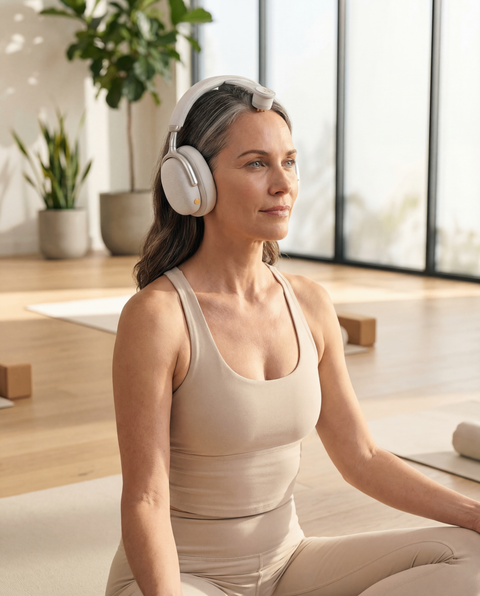
This is the gap Vital's Meditate mode is built for. The headphones read your brain activity with EEG sensors and the soundscape responds to it as the session runs, so the feedback comes from outside your own self-assessment rather than from it. It is not a replacement for learning the skill — nobody gets attention training for free — but it does give the practice an external reference point it otherwise lacks. If you want the underlying mechanism rather than the product, start with what neurofeedback is and how it works, or the rundown of the different types of neurofeedback.
Where to go next
If you are starting meditation for a specific reason, the practical next step depends on which one:
- For sleep, the body scan is the usual starting point, and it works considerably better alongside the rest of your evening routine — see improving your sleep hygiene.
- For stress, meditation is one tool among several, and not always the first one to reach for; stress management techniques covers the wider set.
- For focus at work, short focused-attention sessions before deep work tend to beat long sessions at the end of the day.
Whichever reason brought you here, the first instruction is the same and it is unglamorous: five minutes, one anchor, same time tomorrow. The noticing comes later, and it comes on its own.
Vital Neuro is a general wellness device for relaxation, focus and stress management. It is not a medical device and is not intended to diagnose, treat, cure or prevent any disease. If you have concerns about your mental or physical health, please speak with a qualified professional.